CBN Just Changed the BVN Rules
CBN Just Changed the BVN Rules. Here Is What It Means for Your Business.
If your records are scattered and your books are always "almost ready," this new framework will find you. Before it does, read this.
You probably saw the news headline, forwarded it to your accountant with a quick "please check this" voice note on WhatsApp, and moved on. You had stocks to sort, clients to chase, or payroll to approve.
That exact habit is what the CBN's new BVN framework is built to catch.
It’s not because you aren’t running your business well. It’s because that "we’ll sort the papers later" approach completely fails in a banking system that now judges your business in real time. This isn’t a routine paperwork update. It is the banking system asking a blunt question: can your business actually explain its transactions?
So, What Actually Changed?
The CBN has pushed Nigerian banks into automated, real-time transaction monitoring. In plain terms, an automated compliance engine is now constantly cross-checking your bank profile against your personal BVN, your tax filings, and your internal books.
There is no friendly account officer sitting at a desk deciding to review your folder anymore. The system doesn’t phone ahead, and it doesn't care how big your transaction volume is. The moment a mismatch pops up, an automated flag goes off and your access gets restricted. Learn more about how these policies are shaping the country by reading the Central Bank of Nigeria Official Reform Agenda.
To keep your business running without an unexpected, paralyzing pause, three specific pieces of your identity must align perfectly:
Your Corporate Identity: Your name at the bank must match your director’s NIBSS BVN record character for character. Not your trading name, not a casual abbreviation. The exact registered legal name from the CAC. Discover how this identity layer acts as a foundation across the entire banking ecosystem via the NIBSS Case Study on Financial Regulation.
Your Taxes: Your Tax Identification Number must be active and current on the NRS Rev360 portal. A dormant TIN, a missing filing history, or records that do not reflect your real transaction volume will trigger a red flag.
Your Books: Your invoices and payment records must match what is landing on your bank statement. Every inflow needs a corresponding document in your books. Every outflow needs a clear receipt or record.
Why This Matters for SMEs
Large corporations have compliance teams: lawyers, tax consultants, and dedicated finance staff whose only job is to keep the records clean. Most growing Nigerian businesses do not have that. One accountant is handling payroll, VAT, reconciliation, supplier payments, and internal cost all at the same time.
Records get updated when there is time. Receipts get sorted when someone remembers. This is not laziness. It is what pushing volume without the right tools looks like. But under the new framework, that gap between what happened and what is recorded is exactly where the automated checks land. Review the implementation of these tighter guidelines in the report by the Premium Times Coverage on Tightened BVN Rules.
Be honest with yourself here:
If your bank calls you right now demanding a clean, 90-day transaction breakdown, how many hours or days will it take your team to piece it together?
Can you confirm that every inflow on last month’s statement has a matching invoice or receipt in your records?
Is your filing history on the NRS Rev360 portal actually reflecting the true volume moving through your accounts?
Is there a single mobile phone in your office handling all corporate banking approvals and tokens?
If any of those questions made you uncomfortable, your business has work to do. Not tomorrow. Now.
Month-end reconciliation was fine when banking moved slowly. But with the system monitoring your transactions as they happen, that will not work. These habits will expose you. Understand the impact of these changes on digital applications and mobile compliance via the Manifield Solicitors Review of CBN Operational Guidelines.
What a Structured Business Looks Like Under These Rules
Building a structured business doesn't mean hiring an expensive team of accountants. It just means putting a system in place where your records and your reality match every single day.
Real financial structure means tracking your business data in real time, not via a backlog. It means customer invoices are matched to payments the moment they clear, and suppliercost are logged the day they happen, instead of being reconstructed from old transfer receipts weeks later. Instead of guessing numbers when the tax authority sends a notice or estimating payroll deductions the night before a deadline, VAT, WHT, and PAYE are tracked automatically as they occur. Your bank statements reconcile continuously, so when anyone asks for the numbers, the answer is already ready, never in progress.
Putting an End to the Chaos
You cannot fight automated banking algorithms with human memory or messy Excel sheets. To remove the stress completely, you need an accounting tool built specifically for this exact Nigerian regulatory headache.
That is where Countam comes in. Countam is an accounting software designed specifically for the realities of growing Nigerian businesses. It wasn’t designed for a generic global market; it was built from scratch to solve our specific local operational bottlenecks.
The system acts as your automated bookkeeping assistant, instantly linking bank inflows to real customer invoices as they clear, tracking cost on the fly, and handling your VAT, WHT, and payroll tax calculations in the background using live transaction data. Beyond just basic bookkeeping, it manages your inventory tracking, multi-revenue streams, and generates instant cash flow statements without breaking a sweat.
Plus, with its built-in Role-Based Access, you can finally stop risking your business security by sharing a single phone or password for office transactions. Your cashier logs sales, your manager tracks inventory, and the sensitive financial data stays private to you.
Countam ensures your books and your bank statements tell the exact same story every single day, keeping your corporate access wide open and your business completely safe from unexpected freezes. That is what no-wahala accounting looks like.
Your records should speak for your business. Every day.
Protect your corporate bank access before the next compliance wave hits.
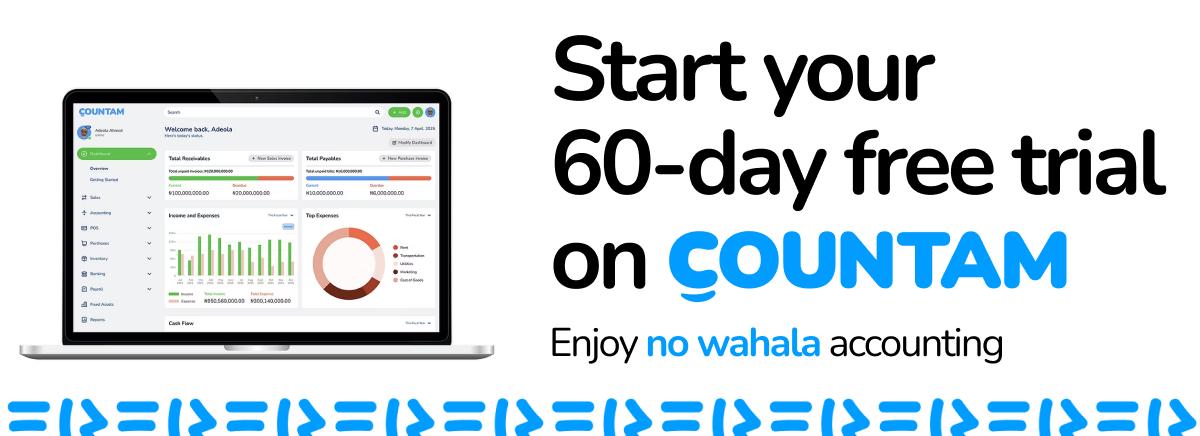
Click here to start your 60-day free trial on Countam today.
Enjoy No Wahala Accounting