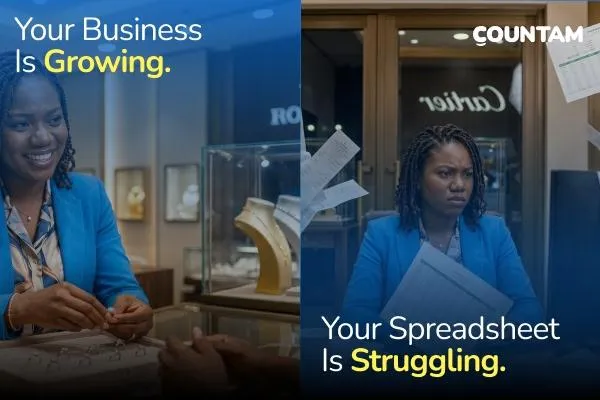
Your Business Is Growing. Your Spreadsheet Is Struggling.
Your Business Is Growing. Your Spreadsheet Is Struggling.
There is a moment many growing Nigerian businesses know too well.
The business is moving. Sales are coming in. Customers are paying by transfer. Stock is leaving the warehouse. Suppliers are calling. Salaries are due. VAT is waiting. PAYE is waiting. The owner is busy chasing growth.
Then one email enters. “Kindly send your updated financial records.”
It may come from a bank, an investor, a tax adviser, or a major customer. Sometimes, it even comes from the accountant who has been asking for the same receipts for three weeks.
That is when the office becomes quiet. Someone opens the sales spreadsheet. Someone else checks WhatsApp for payment confirmations. Another person starts downloading bank statements. Receipts are pulled from drawers, bags, phones, and “that folder on the laptop.” The business that looked organised from the outside suddenly starts running around to prove what it already knows it has been doing.
That is the spreadsheet trap.
Spreadsheets are not useless. Many serious businesses started with them. In the early days, they made sense. The owner still knows most customers by name. Transactions are few. Stock is easy to remember. Costs are manageable. One person can update the file at the end of the day and still have a fair idea of what is going on.
But growth changes everything. As the business gets bigger, money starts moving faster than the spreadsheet can follow. Transfers come in at different hours. POS records do not always match bank alerts. Suppliers change prices. Staff submit costs late. Stock moves from one branch to another. A customer pays part now and part later. The accountant is waiting for documents. The owner is waiting for clarity.
On paper, the business is growing. Inside the numbers, wahala is building.
The real danger is not that the spreadsheet will crash. The bigger danger is that it will give you confidence without giving you the full truth.
It may show sales, but not whether cash is actually improving. It may show stock movement, but not what is tying down money. It may show revenue, but not the deductions, unpaid invoices, supplier balances, and tax obligations sitting behind it.
That is how a business can be busy and still be blind.
A shop can look active and still be losing margin. A distributor can move plenty of stock and still have a poor cash position. A service business can invoice well and still struggle with payroll because collections are unclear. A company can think tax is “under control” until VAT, WHT, and PAYE become emergency work.
This is not because the business owner is careless. Many Nigerian business owners are doing serious work under serious pressure. The problem is that the business has outgrown memory, scattered records, and Friday-evening updates.
At a certain level, financial control cannot depend on who remembered to update the spreadsheet. The business needs one place where sales, inventory, payroll, invoices, tax records, and financial reports connect properly; not one version in Excel, another version in WhatsApp, another version in the bank statement, and another version in someone’s head.
This is where Countam comes in.
Countam is built for Nigerian businesses that need their numbers to behave before pressure comes. It helps you put every sale, cost, stock movement, payroll item, and tax record where it belongs, so your business is not rebuilding its financial story every time someone asks for it.
When the bank asks, your numbers should not start running around. When tax season comes, VAT, WHT, and PAYE should not become panic work. When stock is moving, you should know what is selling, what is sitting, and what is tying down cash. When the business is growing, your records should grow with it.
Spreadsheets may help you start, but they should not be the system holding your next level together.
In 2026, the serious business is not the one shouting growth the loudest. It is the one that can see its numbers clearly, explain them confidently, and act before wahala arrives.
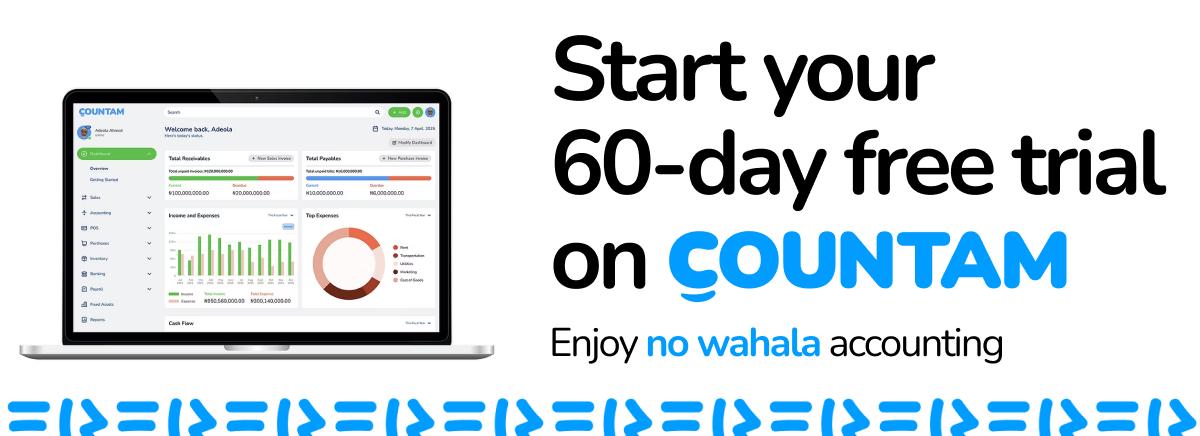
If your business has outgrown scattered records now, Start your 60-day trial on countam